ISyE's May Seminar
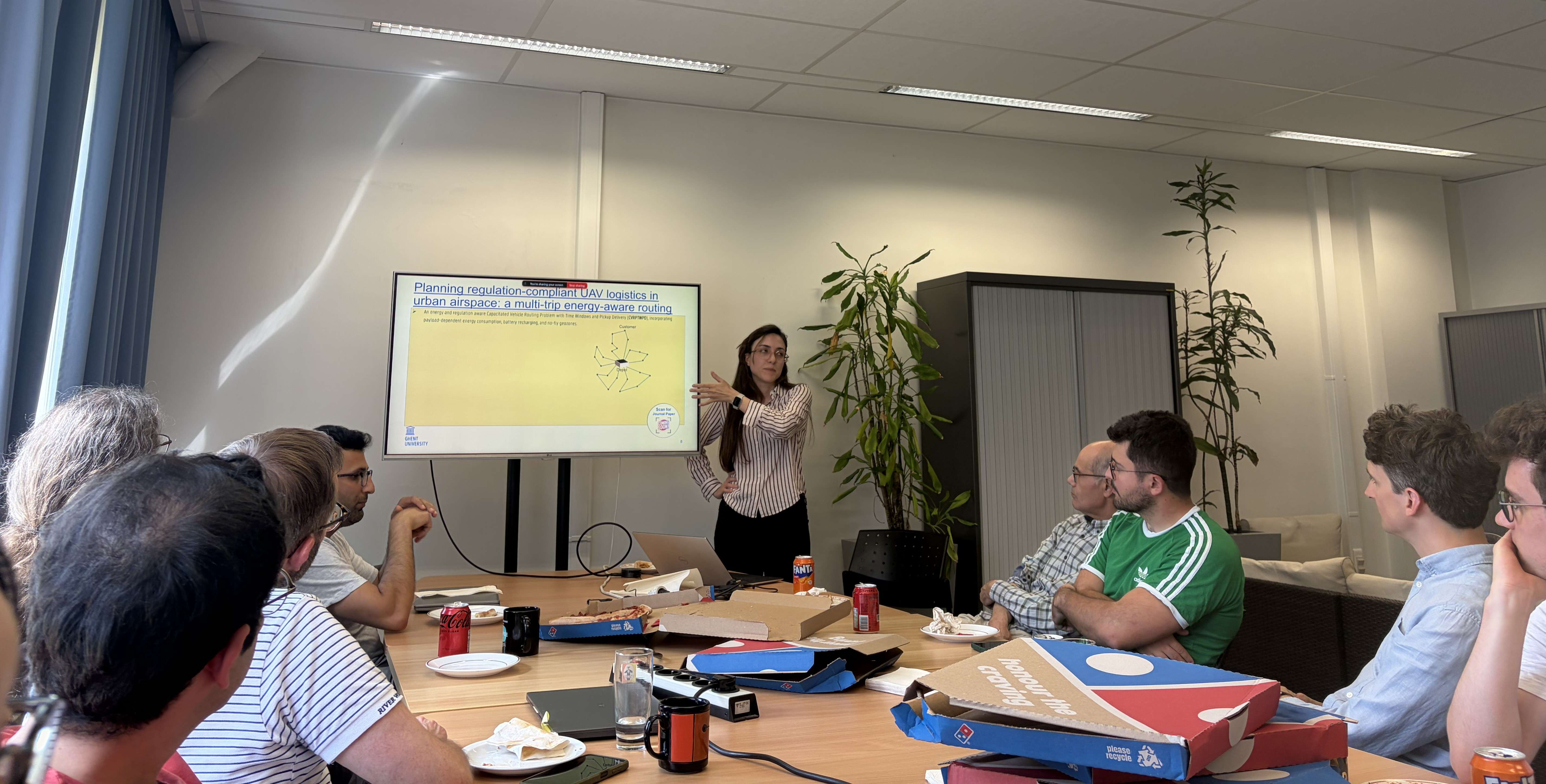
(04-06-2026) In May, our research group once again had the pleasure of hosting an engaging ISyE Lunch Seminar, continuing our tradition of sharing knowledge and fostering discussion within our community. We were delighted to feature two of our researchers as speakers: Elham and Mahdi.
The seminar
Elham Fakhraian and Mahdi Mokhtarzadeh both delivered insightful and thought-provoking presentations.Elham presented with an inspiring and accessible session titled "Drone 101: Master the Skies is back". Mahdi followed her with his work on "pFMEA-based Decision-Support Systems for Quality Management".
These seminars continue to provide a valuable platform for exchanging ideas, learning from each other, and strengthening collaboration within our group. A big thank you to both speakers for sharing their expertise, and to everyone who joined us and contributed to the lively discussions!
Get involved on this topic through our LinkedIn.
Elham's "abstract"
The first part of the presentation introduced the vehicle routing problem for drones, with a focus on the importance of selecting an appropriate solver based on the specific characteristics of the problem.The second part was an interactive Kahoot quiz game designed to guide participants through key aspects of drone operations within the European Union. The aim of this activity was to provide an engaging way to understand what it takes to operate drones legally and safely.
Mahdi's abstract
Industry 5.0 emphasizes the role of human intelligence in enhancing context-aware decision-making. In quality management, integrating expert knowledge from pFMEA with operational data from quality control plans and factory-floor measurements can strengthen decision support for failure analysis and problem-solving. However, this integration is challenged by structural and semantic misalignment between the detailed, qualitative, and low-level failure descriptions in pFMEA and the more process-oriented, aggregated operational data collected at higher system levels. In this presentation, a decision-support system is presented, structured around a data-fusion and inference layer supported by knowledge management and system interface layers.The data-fusion layer transforms pFMEA into a Bayesian-based, data-supported model, enabling its integration with quality control and factory-floor data. Finally, practical considerations and limitations are discussed, including variable definitions, data segmentation strategies, failure analysis contexts, and dependency structures. Key limitations include incomplete pFMEA, poor text quality, ambiguity in occurrence ratings, and inconsistencies in mapping operational data to pFMEA knowledge.