A look inside ISyE's March Seminar
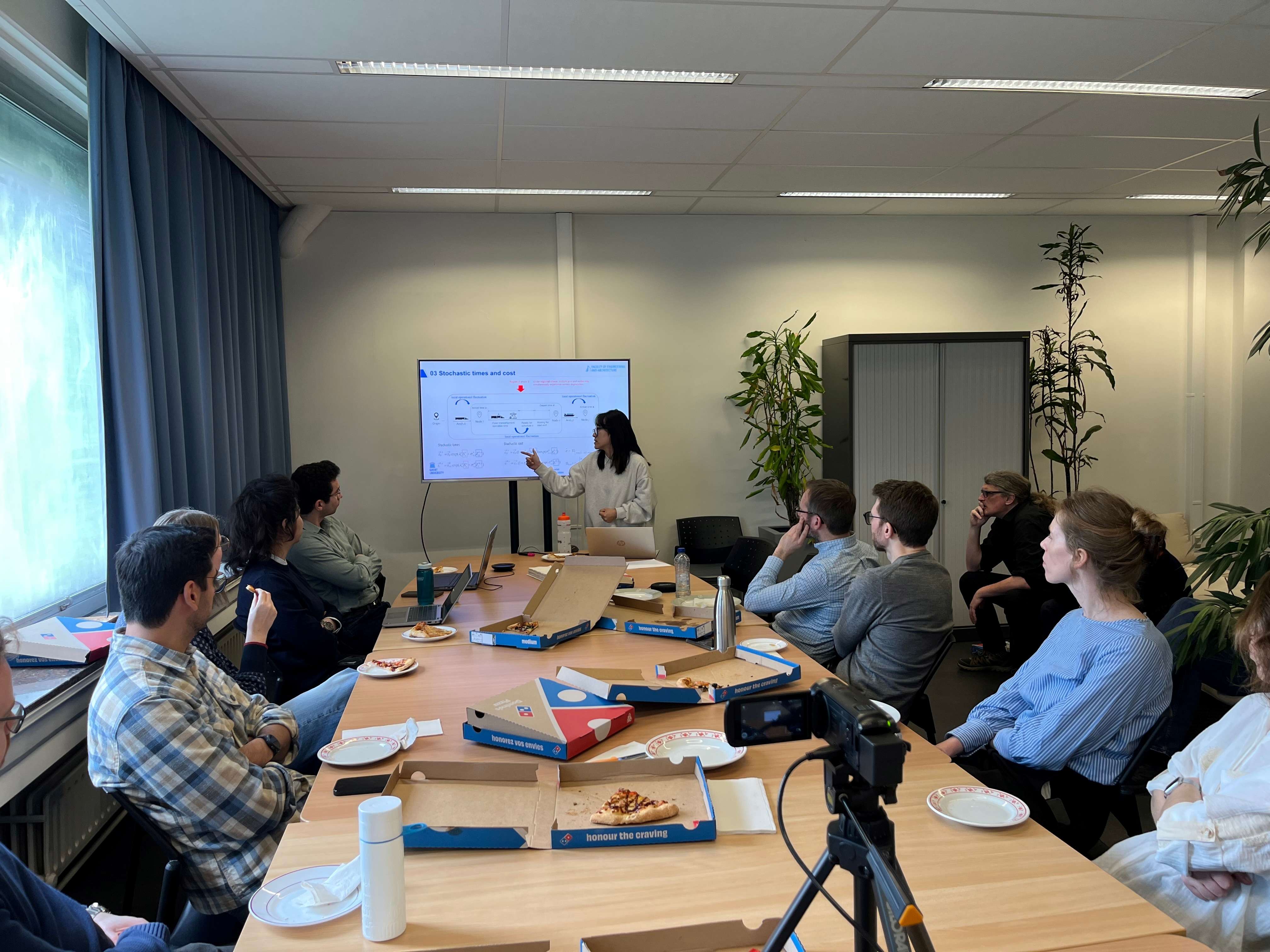
(10-03-2026) Another month, another engaging ISyE seminar. This edition featured talks by Yang Xiao and Reza Ghorbani, who shared their research on advanced optimization techniques for transport networks and complex planning problems.
Yang Xiao presented on "Risk-aware Route Selection in Multimodal Transport Networks: The Case of Heavyweight and Oversized Freight". Managing risks in multimodal transport is essential for improving operational efficiency and sustainability, especially in complex networks involving multiple modes and regions. Yang's study proposes a Copula-CVaR framework to enhance risk assessment and route optimization in multimodal transport. The framework leverages Conditional Value-at-Risk (CVaR) to evaluate the impact of extreme but plausible risks, while a copula function is employed to capture the dependence between random variables related to link and node transit risks, ensuring more accurate risk estimation. A multi-objective optimization model is developed incorporating various objectives, including total cost, total time and total carbon emissions. Monte Carlo simulation is used to approximate the joint distribution of risks. The model is solved using an improved non-dominated sorting genetic algorithm. A case study focused on heavyweight and oversized freight is used to establish the validity of the model and algorithm.
Reza Ghorbani presented on "Logic-based benders decomposition and its application in planning and scheduling". To address the inherent complexity of large-scale optimization, decomposition methods leverage problem structure to iteratively solve manageable subproblems through the exchange of information. Logic-Based Benders Decomposition (LBBD) is a generalization of the classical Benders decomposition technique that, in principle, allows the subproblem to be any optimization problem rather than specifically a linear or nonlinear programming problem. Reza provided an overview of the decomposition techniques and their applications and then delved into the logic-based Benders decomposition technique with a specific application in addressing the integrated flexible job shop scheduling and operator time tabling problem.
Thank you to both our speakers. We were also delighted to welcome our special guests Zumbul Atan (professor at Technische Universiteit Eindhoven (TU/e) and scientific director of the Beta Network) and Renzo Akkerman (professor at Wageningen University & Research).
Get involved on this topic on our LinkedIn.
Reza Ghorbani presented on "Logic-based benders decomposition and its application in planning and scheduling". To address the inherent complexity of large-scale optimization, decomposition methods leverage problem structure to iteratively solve manageable subproblems through the exchange of information. Logic-Based Benders Decomposition (LBBD) is a generalization of the classical Benders decomposition technique that, in principle, allows the subproblem to be any optimization problem rather than specifically a linear or nonlinear programming problem. Reza provided an overview of the decomposition techniques and their applications and then delved into the logic-based Benders decomposition technique with a specific application in addressing the integrated flexible job shop scheduling and operator time tabling problem.
Thank you to both our speakers. We were also delighted to welcome our special guests Zumbul Atan (professor at Technische Universiteit Eindhoven (TU/e) and scientific director of the Beta Network) and Renzo Akkerman (professor at Wageningen University & Research).
Get involved on this topic on our LinkedIn.