ISyE's December seminar
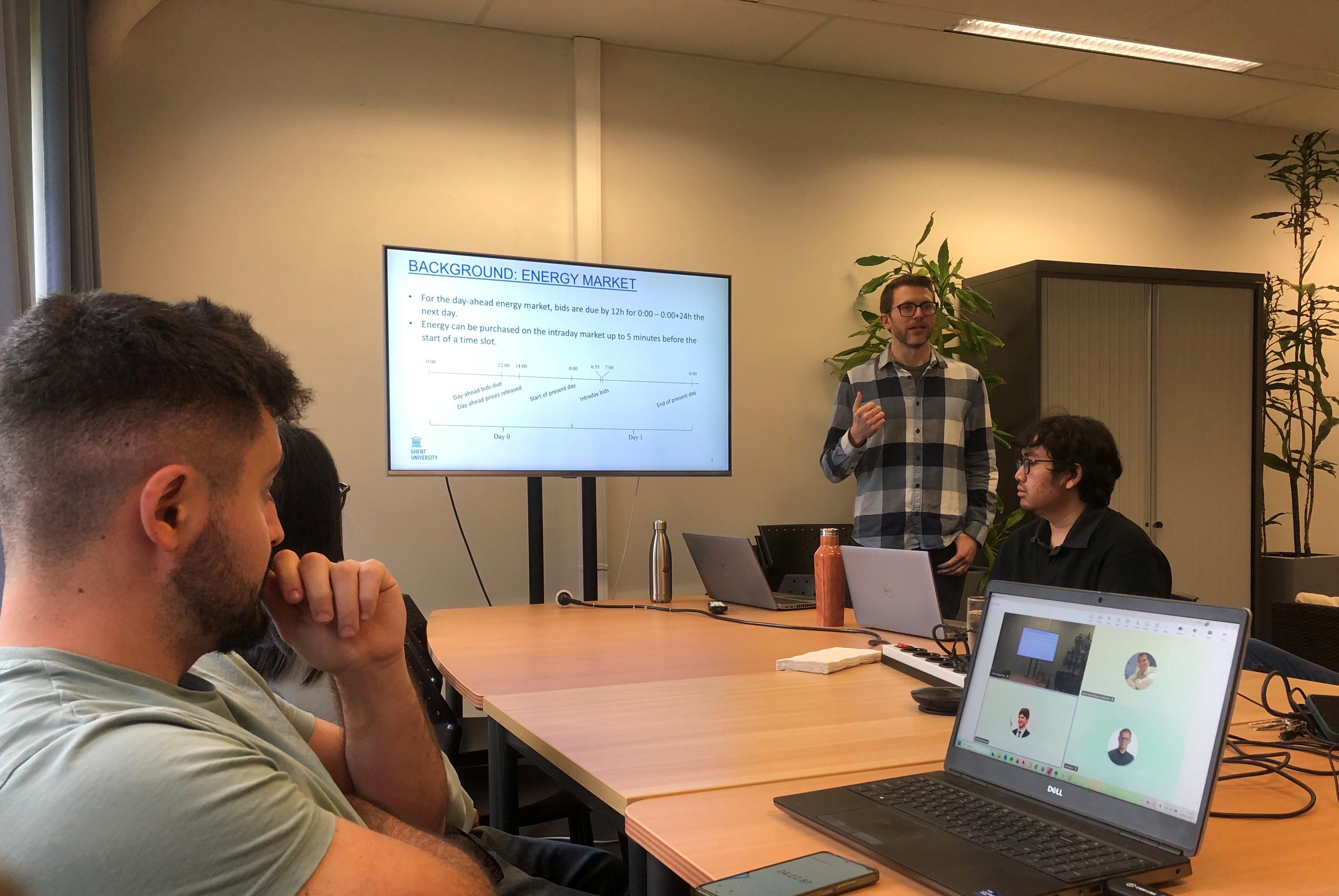
(15-12-2025) Have a look at our ISyE's seminar of December. Our seminar featured two inspiring research talks, bringing together insights from energy systems and urban mobility. Our researchers Robert Hanusa and Muhammad Farhan Fathurrahman presented their research on these topics.
Rob Hanusa spoke on "A production planning tool accounting for uncertainty in renewable energy forecasts" and Muhammad Farhan Fathurrahman spoke on "An Introduction to Large-Scale Urban Traffic Signal Control, and How We Tackle It". Rob highlighted how uncertainty can be effectively integrated into decision-making models, while Fathur offered clear perspective on the challenges and approaches in managing complex urban traffic networks.
Many thanks to both speakers for their engaging and thought-provoking contributions.
Read their abstracts below!
Want to get involved on this topic? Then join the conversation on our LinkedIn post.
In this presentation, I first discuss a model that optimizes the energy planning of an electrically-powered chemical reactor. Then, I show how we can present the model in an appealing way to industrial users by making a dashboard that (1) visualizes the model in a way that is interpretable, and (2) permits flexibility by allowing manual adjustments to the output. Presenting complex models in this way can make it easier for a skeptical industrial user to implement them at their facility.
Various approaches have been developed to address this problem, from conventional methods such as SCATS and SCOOT, control-theoretic approaches like Traffic-responsive Urban Control (TUC) and max-pressure, to more recent reinforcement learning (RL) approaches. Despite these advances, deploying effective traffic signal controllers for large-scale urban networks in the real world remains challenging.
In this presentation, I will introduce the fundamental challenges in this domain and explain why they persist. I will then address these challenges through three key areas of work: (1) enhancing traffic flow predictions and data imputation using spatiotemporal graph-based approaches, with evaluation from spatial perspectives; (2) exploring the effects of data inaccuracies on traffic signal control performance; and (3) examining critical issues in RL approaches, such as systematic biases in learned policies and interpretability challenges.
Many thanks to both speakers for their engaging and thought-provoking contributions.
Read their abstracts below!
Want to get involved on this topic? Then join the conversation on our LinkedIn post.
Robert Hanusa's abstract
In academia, we create models that can aid in solving many complex problems that arise in industry. However, it is not always straightforward to convince industrial users to use our models.In this presentation, I first discuss a model that optimizes the energy planning of an electrically-powered chemical reactor. Then, I show how we can present the model in an appealing way to industrial users by making a dashboard that (1) visualizes the model in a way that is interpretable, and (2) permits flexibility by allowing manual adjustments to the output. Presenting complex models in this way can make it easier for a skeptical industrial user to implement them at their facility.
Muhammad Farhan Fathurrahman's abstract
Urban traffic congestion poses significant challenges to modern cities, affecting economic productivity, environmental sustainability, and quality of life for millions. Managing traffic across complex large-scale networks comprising dozens or hundreds of intersections significantly amplifies these challenges.Various approaches have been developed to address this problem, from conventional methods such as SCATS and SCOOT, control-theoretic approaches like Traffic-responsive Urban Control (TUC) and max-pressure, to more recent reinforcement learning (RL) approaches. Despite these advances, deploying effective traffic signal controllers for large-scale urban networks in the real world remains challenging.
In this presentation, I will introduce the fundamental challenges in this domain and explain why they persist. I will then address these challenges through three key areas of work: (1) enhancing traffic flow predictions and data imputation using spatiotemporal graph-based approaches, with evaluation from spatial perspectives; (2) exploring the effects of data inaccuracies on traffic signal control performance; and (3) examining critical issues in RL approaches, such as systematic biases in learned policies and interpretability challenges.