September's ISyE seminar
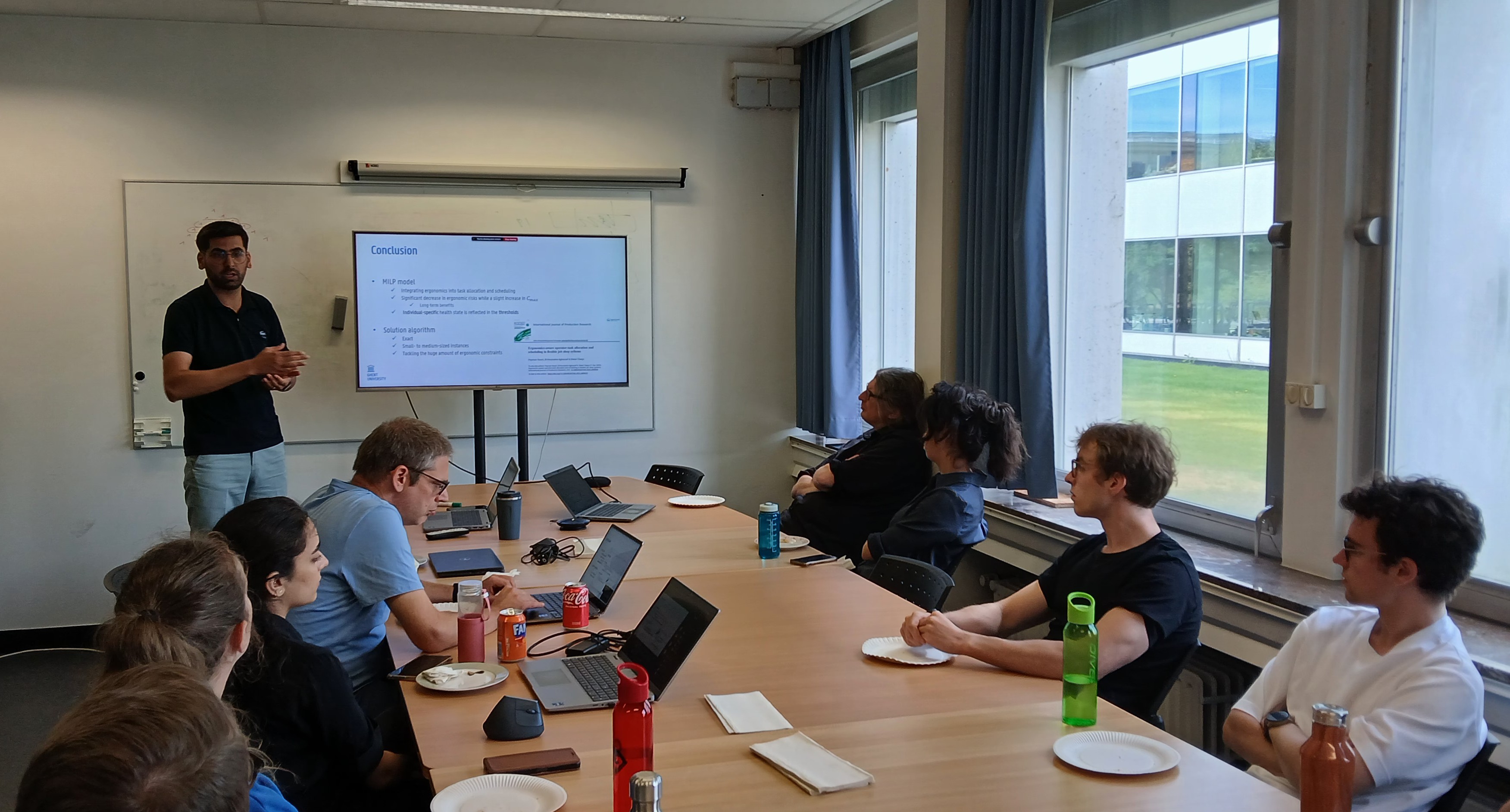
(15-09-2025) Have a look into our monthly ISyE seminars! For September's internal ISyE seminar in Zwijnaarde, we heard from our researchers Peyman Yasari and Gohar Porbar.
Peyman Yasari spoke on "Well-being-aware Task Allocation and Scheduling" and Gohar Porbar on "Tactical Optimization for Part Feeding in Mixed Model Assembly Lines".
In today’s work environment, the importance of well-being is undeniable. A lack of physical well-being leads to musculoskeletal disorders, while a lack of mental well-being contributes to worker burnout. Both issues result in significant losses in time, energy, and financial resources for industries. Although the primary stage for addressing these aspects is during task and workstation design, it is also possible to manage resources to balance and adjust workloads during the operational phase. This presentation showcases a tool developed to integrate ergonomic aspects into workers’ daily schedules, delivering long-term benefits for both employees and companies, while minimizing short-term productivity loss.
In the current competitive market, the growing demand for customized products requires manufacturers to produce a wide range of product variants. Mixed-model assembly lines allow these product variants to be assembled on the same line. However, limited Border of Line (BoL) space makes storing large quantities of parts impractical. To address this constraint, manufacturers use various part-feeding policies. The BoL space usage can be reduced by grouping and repackaging parts into smaller containers; however, this increases logistics costs.
We look at five part-feeding policies: Line Stocking (full pallets at the BoL), Boxed Supply (repackaging parts into smaller boxes), Sequencing (presenting parts in assembly order), Stationary Kitting and Traveling Kitting (grouping parts required for a single product). Depending on its characteristics and demand, each part can be assigned to a feeding policy. These policy assignments impact space utilization, material flow, logistics and operational costs.
Our research proposes an exact solution approach to optimize policy assignments while minimizing logistics costs. The developed MIP formulation accounts for real-world constraints, including vehicle fleet, fixed layout, preparation cell sizes and limited BoL space. The model is validated using a variety of real-world instances. By integrating real-world constraints, this model serves as a decision-support tool to help manufacturers in making better informed part-feeding decisions.
A big thank you to both speakers for sharing their impactful research!
Peyman on "Well-being-aware Task Allocation and Scheduling"
Peyman highlighted how both physical and mental well-being are critical for sustainable productivity. His work presents a tool that integrates ergonomic aspects into daily schedules for balancing workloads, supporting employees, and minimizing productivity loss in the short term.In today’s work environment, the importance of well-being is undeniable. A lack of physical well-being leads to musculoskeletal disorders, while a lack of mental well-being contributes to worker burnout. Both issues result in significant losses in time, energy, and financial resources for industries. Although the primary stage for addressing these aspects is during task and workstation design, it is also possible to manage resources to balance and adjust workloads during the operational phase. This presentation showcases a tool developed to integrate ergonomic aspects into workers’ daily schedules, delivering long-term benefits for both employees and companies, while minimizing short-term productivity loss.
Gohar on "Tactical Optimization for Part Feeding in Mixed Model Assembly Lines"
Gohar addressed the growing demand for customized products and the challenges of limited storage in assembly lines. By comparing five part-feeding policies, his research proposes an optimization model that helps manufacturers assign the right feeding policy to each part. Thus reducing logistics costs while respecting real-world constraints.In the current competitive market, the growing demand for customized products requires manufacturers to produce a wide range of product variants. Mixed-model assembly lines allow these product variants to be assembled on the same line. However, limited Border of Line (BoL) space makes storing large quantities of parts impractical. To address this constraint, manufacturers use various part-feeding policies. The BoL space usage can be reduced by grouping and repackaging parts into smaller containers; however, this increases logistics costs.
We look at five part-feeding policies: Line Stocking (full pallets at the BoL), Boxed Supply (repackaging parts into smaller boxes), Sequencing (presenting parts in assembly order), Stationary Kitting and Traveling Kitting (grouping parts required for a single product). Depending on its characteristics and demand, each part can be assigned to a feeding policy. These policy assignments impact space utilization, material flow, logistics and operational costs.
Our research proposes an exact solution approach to optimize policy assignments while minimizing logistics costs. The developed MIP formulation accounts for real-world constraints, including vehicle fleet, fixed layout, preparation cell sizes and limited BoL space. The model is validated using a variety of real-world instances. By integrating real-world constraints, this model serves as a decision-support tool to help manufacturers in making better informed part-feeding decisions.
A big thank you to both speakers for sharing their impactful research!